The first Vietnam hire is easy to imagine. A strong developer, a clear role, a few hours of overlap with your European team, and the work starts moving.
The harder part starts after the offer. Someone has to own the contract path, payroll handoff, onboarding checklist, tool access, delivery rhythm, feedback loop and security rules. If those pieces are solved after the candidate accepts, your remote team starts with delays before the work has even begun.
To build a remote team in Vietnam that works beyond the first hire, EU and Dutch companies need an operating model before sourcing starts. This guide shows how to move from first role to stable operations, with clear decisions for hiring route, recruitment, employment setup, onboarding, access control and scale.
If you are still deciding whether to handle search internally or bring in outside support, Sunbytes’ recruitment services in Vietnam can help connect role definition, shortlist quality and hiring route planning before the first role opens.
TL;DR
- Start by choosing the right hiring model (direct hire, recruitment, staffing, EOR or dedicated team), then move step by step from role definition to sourcing, hiring, onboarding and daily operations with clear ownership at each stage.
- Build a strong foundation from day one by setting up contracts, payroll, tools, access, onboarding and a clear working rhythm between EU and Vietnam teams.
- Scale your team gradually: ensure clarity for the first hire, establish processes for small teams, and add local support and governance as you grow to full operations.
When building a remote team in Vietnam makes sense
Building a remote team in Vietnam makes sense when your company needs repeatable hiring, not a one-off contractor. It fits EU and Dutch teams that expect to hire more than one role, need long-term product or engineering capability, and can manage work through a 4–5 hour NL–VN overlap.
Vietnam can work well for companies building engineering, QA, DevOps, data, support or product-adjacent capacity. But the reason should be operational, not only cost. A Vietnam-based team needs role clarity, manager capacity and a working rhythm that lets people contribute without waiting for Europe to wake up.
A Vietnam tech talent market overview helps your team decide which role to open first, which skills may need a longer search and which seniority level is realistic for your hiring timeline.
This setup usually fits when your company has at least one of these conditions:
| Fit signal | What it means for your team |
|---|---|
| You expect repeated hiring | A single hire may be enough now, but you expect 2–10 Vietnam-based roles over the next 6–18 months. |
| You need long-term product knowledge | The role is tied to your codebase, product roadmap, clients or internal systems. |
| Your internal team can manage remote output | Someone in Europe can review work, make decisions and unblock the Vietnam team during overlap hours. |
| You want more control than project outsourcing | You need people integrated into your team, not only a fixed-scope delivery vendor. |
A remote team is not the right move if your requirements are still unclear, your internal owner is missing, or the role is only needed for a short task. In that case, a project-based delivery partner or short-term contractor may be safer than building a team you are not ready to manage.
Choose the right operating model before you hire
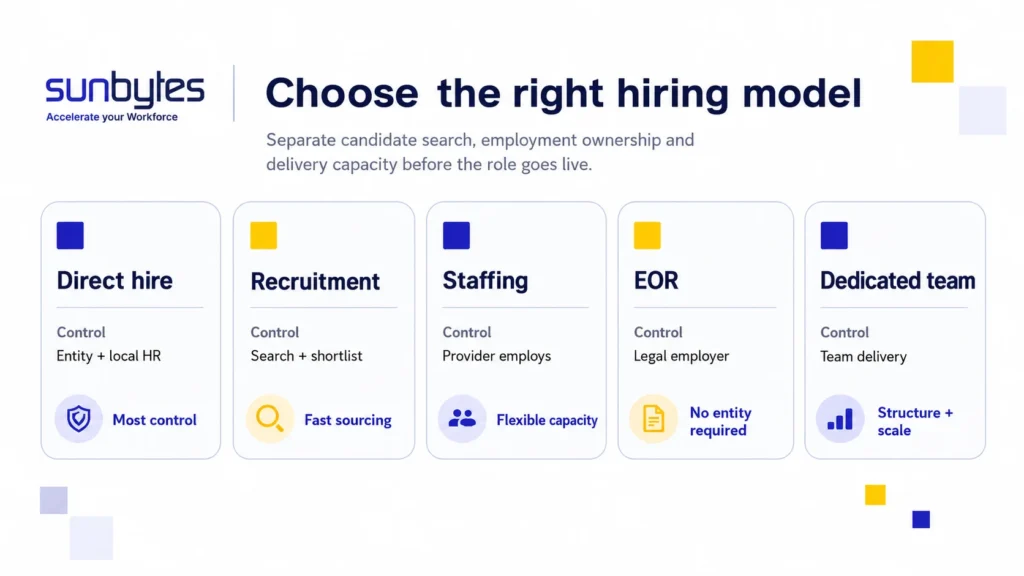
The right operating model depends on what your company needs to own. Some companies need help finding candidates. Others need a legal employer in Vietnam. Others need a managed delivery team because hiring individuals no longer solves the work.
This decision should happen before the job description goes live. If you choose the model after the candidate accepts, the offer can stall while legal, payroll, access and management responsibilities are still being assigned.
For the staffing side of the decision, the Sunbytes staffing services guide explains how staffing, EOR, COR and IT staffing differ in practice. A deeper RPO vs staffing vs EOR in Vietnam comparison can help your team separate search ownership, employment ownership and workforce capacity before choosing a route.
| Model | What you control | Who employs or contracts the worker | Speed | Compliance owner | Best fit | Watch-out |
|---|---|---|---|---|---|---|
| Direct hire | Hiring, employment, management and payroll | Your Vietnam entity | Medium | Your company | You already have a local entity and HR/payroll setup | Not suitable if you have no legal employer in Vietnam |
| Recruitment agency | Candidate sourcing and selection decision | Your company or chosen employer setup | Fast for shortlist | Your company or chosen employer setup | Search and screening are the bottleneck | Recruitment does not solve employment setup by itself |
| Staffing | Capacity and day-to-day work direction | Staffing provider | Fast | Staffing provider for employment setup | You need capacity without building full HR infrastructure | Control and long-term retention may differ by model |
| EOR | Work direction and role management | Employer of Record | Medium to fast | EOR for local employment administration | You have selected a hire but have no Vietnam entity | EOR does not replace technical management |
| Dedicated team | Team priorities and product direction | Delivery or team provider, depending on setup | Medium | Provider depending on contract | You need team-level delivery capacity, not only headcount | It can be too much for one isolated role |
Direct hire gives the most control, but it only works when local employment readiness already exists. Your company needs a Vietnam entity, local employment contracts, payroll registration, social insurance handling, personal income tax withholding and HR records. Vietnam’s employment framework is set out in the Vietnam Labour Code 2019 via ILO NATLEX.
Recruitment works when search is the bottleneck. You know the role, you can employ the person, and you need stronger sourcing, screening and shortlist speed. For Sunbytes recruitment projects, the operating benchmark is time-to-shortlist in 3 days from brief sign-off where the role is clear and the candidate market supports it.
If you are comparing external recruitment partners, the Sunbytes article on top recruitment service companies in Vietnam can support provider research. A more focused how to choose a recruitment agency in Vietnam guide should sit next to this decision when your team is already shortlisting vendors.
EOR works when the candidate can be found, but employment setup is the blocker. This is common for EU companies hiring the first Vietnam-based employee without a local entity. The recruitment process finds the person. The EOR model makes the person employable in Vietnam. If you need the full legal-employment model first, read Employer of Record in Vietnam. A dedicated recruitment vs. EOR in Vietnam comparison is useful when your team is unsure where candidate search ends and legal employment setup begins.
Dedicated team support becomes relevant when delivery ownership matters more than adding another person. If your EU manager is spending more time translating priorities, checking status and coordinating tasks than making product decisions, recruitment alone may no longer be enough. This is where Sunbytes can bridge into a dedicated software development team or Team as a Service model when the problem moves from hiring to delivery capacity.
Need to know whether your first Vietnam role is ready for sourcing? Sunbytes recruitment services help EU teams define the role, validate the hiring route and prepare the shortlist process before outreach starts.
Phase 1: define the role before sourcing starts
A Vietnam remote team starts with role priority, reporting line, budget and ownership. The job post should come after those decisions, not before them.
Your first role should reduce the highest operating bottleneck. That may be backend delivery, QA coverage, DevOps support, mobile development, data engineering or product maintenance. Hiring the cheapest available role first can create more coordination work for your European team if the role does not solve the right problem.
Before sourcing starts, define the role scorecard, seniority level, reporting line, salary range, English requirement, overlap expectation and interview owner. The scorecard should separate must-have skills from trainable skills, define what “good” looks like after 30 and 90 days, and name who makes the final hiring decision.
A Vietnam candidate should not have to guess whether the role is contractor, employee, EOR-based, hybrid, remote-first, product-led or project-based. Before publishing the JD, check writing job descriptions for Vietnam engineers to make the role clearer for both candidates and recruiters.
The first internal owner matters more than most teams expect. When no one owns feedback, a strong candidate can wait three days after interview before hearing anything. In that time, they may already be in another process. This is why Sunbytes treats shortlist speed and decision rhythm as part of recruitment, not admin. Time-to-shortlist: 3 days from brief sign-off where the role is clear.
Phase 2: source and assess Vietnam candidates
Vietnam sourcing works faster when the brief is localised and the assessment checks both technical fit and remote working behaviour. A candidate who writes strong code but cannot document decisions, raise blockers or work across time zones may still create friction inside your team.
For Vietnam roles, the sourcing brief should state role scope, expected output, tech stack, seniority level, English requirement, remote policy, salary band, interview steps, expected start date and employment route if known.
A Europe-style job description often assumes too much. A Vietnam candidate should not have to guess whether the role is contractor, employee, EOR-based, hybrid, remote-first, product-led or project-based.
The assessment should cover three areas. First, check technical fit with a practical task, code review, architecture discussion or live technical interview that matches the real work. Second, check communication fit by asking the candidate to explain a past technical decision, a blocker they raised or how they handled unclear requirements. Third, check working rhythm. A Vietnam-based hire working with an EU team needs comfort with async updates, written documentation, code review and overlap-hour decisions.
If your role is technical, use IT recruitment in Vietnam to connect the sourcing plan with stack availability, screening steps and employment-route decisions. For shortlist quality, add candidate vetting in Vietnam before final offer so background checks, reference calls and probation handoff do not become late-stage blockers.
A how to assess Vietnamese developers remotely workflow can sit after this step when the reader needs a deeper technical and communication screening method.
For Sunbytes recruitment support, the 3-day shortlist benchmark works when the role scorecard is approved, budget is realistic and interview owners are ready to respond. If the brief changes after sourcing starts, the timeline resets.
Phase 3: move from selected candidate to employment setup
The hire is not operational until contract, payroll, social insurance, personal income tax, work eligibility and data responsibilities are assigned. Recruitment can bring the right person to offer stage, but employment setup decides whether that person can start safely.
For Vietnam-based employees, the employment setup should answer who signs the employment contract, who runs payroll, who handles SHUI and PIT obligations, whether a work permit is needed, and who controls employee and candidate data.
The Vietnam Labour Code 2019 via ILO NATLEX is the key external reference for employment relationships, worker definitions and employer responsibilities. For foreign nationals working in Vietnam, use the Sunbytes Vietnam work permit 2025 guide as a supporting internal link when the role involves non-Vietnamese employees.
If your company has no local entity, do not leave the employer route until after offer acceptance. A selected candidate may be ready to start, but your company still needs a legal employer route. If the employment setup is the main blocker, read Employer of Record in Vietnam and choosing an employer of record provider in Vietnam before signing with a provider.
Data handling also belongs in this phase. EU and Dutch companies need to decide what employee data is collected, where it is stored, who can access it, and which provider handles each processing activity. The EU GDPR requires security of processing under Article 32 of Regulation (EU) 2016/679.
Vietnam’s personal data framework now includes Law No. 91/2025/QH15 on Personal Data Protection, effective 1 January 2026, with Decree No. 356/2025/ND-CP as the current guiding decree. For remote team setup, this means employee data collection, access rights, processor roles, consent records and offboarding deletion rules should be assigned before day one.
This is where Secure supports the operating model. Not as a separate service menu, but as a practical control layer: access approval, device rules, DPA, audit trail, role-based permissions and offboarding access removal.
Phase 4: onboard the team into your operating rhythm
The first 30 days should turn a signed hire into a working team member with tools, documentation, access, feedback rhythm and delivery expectations. A welcome call is not enough.
Before day one, contract path, payroll owner, device setup, account access, email, tools and documentation should be ready. On day one, the hire should understand role expectations, team structure, security rules and the first tasks. During the first week, the team lead should introduce the codebase, workflow, sprint rituals, feedback format and escalation route. By day 30, the hiring manager should review output, communication, access and probation expectations.
If your hire is going through EOR, the Sunbytes EOR onboarding Vietnam guide can support the document, payroll and handoff timeline before day one.
Use the NL–VN overlap carefully. The 4–5 hour overlap should be protected for decisions, planning, technical discussions, feedback and offer approvals. Status updates should move into written async channels.
Access control should also sit inside onboarding. A new hire should receive only the tools, repositories, documents and client systems required for the role. Access should be reviewed after probation and removed during offboarding. This protects employee data, client data and delivery continuity.
If the role carries client access, sensitive data or probation risk, connect onboarding to candidate vetting in Vietnam so screening evidence and probation checkpoints are not separated from the first 30 days.
Phase 5: scale from first hire to full operations
Scaling should happen when management, payroll, delivery ownership and security checks can keep pace with hiring. Adding headcount before those pieces are ready creates more work for the EU team, not more capacity.
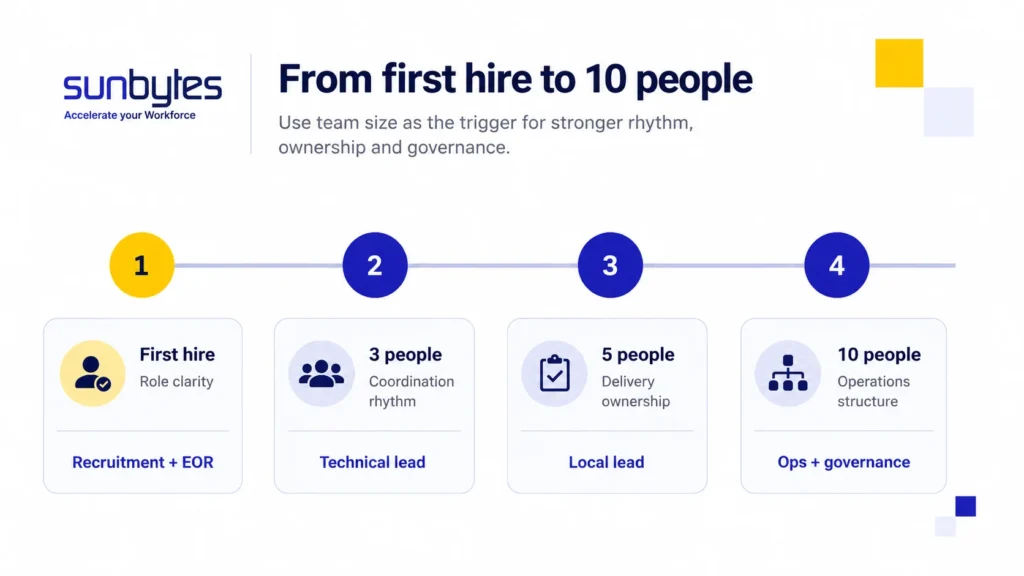
Use team size as a trigger. The first hire needs clarity. Three people need rhythm. Five people need ownership. Ten people need local support and governance.
| Team stage | Main risk | Owner needed | What must be ready | Best-fit support model |
|---|---|---|---|---|
| First hire | Wrong role or weak setup | EU hiring manager plus recruitment owner | Role scorecard, JD, assessment, contract path, access checklist | Recruitment or recruitment plus EOR |
| 3 people | Coordination slows | Technical lead or senior engineer | Sprint rhythm, code review, documentation, payroll cadence | Recruitment plus staffing or EOR |
| 5 people | Management load becomes visible | Delivery owner or local lead | Performance cadence, escalation path, onboarding playbook | Staffing or dedicated team |
| 10 people | HR, payroll, access and delivery need structure | Local lead plus ops support | Local admin, access governance, audit trail, manager cadence | Dedicated team, EOR or team-as-a-service |
At three people, your team needs shared documentation and a predictable planning rhythm. The risk is no longer only hiring quality. The risk is that each person works in a slightly different way.
At five people, delivery ownership becomes visible. Your EU manager may still make product decisions, but someone closer to the team should help with task clarity, handoffs, first-line questions and feedback loops.
At ten people, remote work becomes local operations. HR records, payroll cadence, performance reviews, access governance, device rules, leave tracking and team-level reporting need stronger ownership.
This is where a dedicated software development team or Team as a Service can fit. Recruitment adds people. A dedicated team model adds delivery capacity, team structure and management support. If the reader needs education before speaking to Sales, the article what is a dedicated software development team gives a fuller explanation of how the model works.
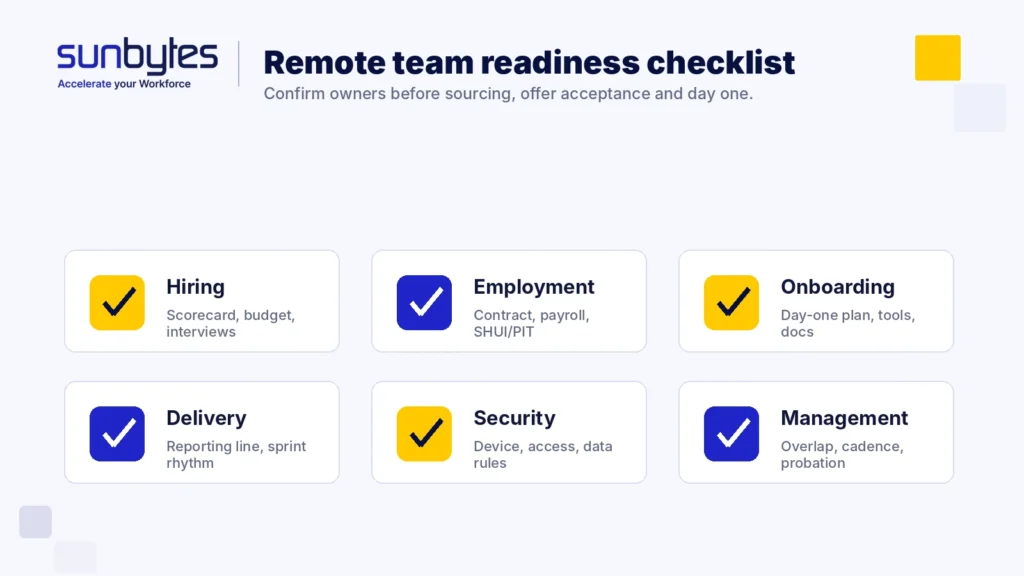
Remote team readiness checklist
A Vietnam remote team is ready to start when hiring, employment, onboarding, delivery, security and management owners are assigned. Use this checklist before opening the role or before moving from one hire to a small team.
| Readiness area | Checklist items |
|---|---|
| Hiring readiness | Role scorecard approved. Salary range or budget band confirmed. Interview process agreed. Assessment owner assigned. |
| Employment readiness | Contract path confirmed. Payroll owner confirmed. SHUI and PIT responsibility assigned. Work permit check completed if relevant. |
| Onboarding readiness | Day-one plan ready. Tool access prepared. Documentation shared. First 30-day expectations agreed. |
| Delivery readiness | Reporting line confirmed. Sprint or work rhythm agreed. Code review and handoff rules written. Escalation path clear. |
| Security and data readiness | Device policy ready. Role-based access approved. Employee data handling agreed. DPA or data processing terms checked where needed. |
| Management readiness | NL–VN overlap window agreed. Manager cadence scheduled. Probation checkpoint set. Scaling trigger reviewed at 3, 5 and 10 people. |
Do not wait until after the candidate signs to complete this checklist. The offer stage should confirm the start date, not reveal that payroll, access and ownership still need decisions.
For the legal employment side, keep the Vietnam Labour Code 2019 via ILO NATLEX close to your employment setup checklist. For data and access control, use GDPR Article 32,Law No. 91/2025/QH15 on Personal Data Protection and Decree No. 356/2025/ND-CP as references when reviewing employee data handling.
How Sunbytes helps EU companies build Vietnam teams
Building a Vietnam team becomes harder when each handoff has a different owner. The recruiter owns the shortlist. The hiring manager owns interviews. HR owns contracts. IT owns access. Someone else handles onboarding. The candidate feels the delay before your team sees the cause.
Sunbytes addresses this through three connected pillars: Accelerate, Transform and Secure.
Accelerate Workforce Solutions focuses on recruitment and hiring speed. Sunbytes recruitment services help EU teams define the role, localise the brief, source Vietnam candidates, screen for technical and communication fit, and prepare the shortlist process before outreach starts. For clear roles with ready decision owners, Sunbytes works toward a 3-day shortlist from brief sign-off and a 14-day hiring path where role fit, market availability and client response speed allow it. The 4–5 hour NL–VN overlap also helps interviews, offer decisions, onboarding and manager check-ins move without late-night routines.
Digital Transform Solutions supports the shift from hiring individuals to building delivery capacity. When your need grows beyond recruitment, Sunbytes can bridge into dedicated team or Team as a Service models. This pillar focuses on team structure, delivery ownership and day-to-day technical execution, ensuring your Vietnam team contributes as an integrated part of your product or engineering organisation.
CyberSecurity Solutions provides the control layer behind the team. It ensures that access rights, employee data handling, DPA support and audit trail readiness are in place before the hire starts. This keeps recruitment connected to a compliant and secure operating setup that protects client data, employee records and offboarding control.
Need to know whether your first Vietnam role is ready for sourcing? Sunbytes recruitment services help EU teams define the role, validate the hiring route and prepare the shortlist process before outreach starts.
FAQs
Start by choosing the operating model, then define the role, source candidates, assess technical and communication fit, complete the employment setup, onboard the hire and create a team management rhythm. Do not start with job posting alone. The setup should assign an owner for each handoff from shortlist to contract, day one and the first 30 days.
There is no single best model. Direct hire fits companies with a local entity and internal HR capacity. Recruitment fits when sourcing and screening are the bottleneck. EOR fits when the company has no Vietnam entity. Staffing fits when capacity is needed quickly. Dedicated team support fits when delivery ownership matters.
The timeline depends on role clarity, stack, seniority, interview speed and offer readiness. As a Sunbytes benchmark, time-to-shortlist can be 3 days from brief sign-off, and time-to-hire can reach 14 days where role fit and decision speed allow. Hard-to-fill roles or unclear assessment steps can extend the process.
Use recruitment when the main problem is finding and assessing the right candidate. Use EOR when the main problem is employing the person legally in Vietnam without a local entity. Many EU companies need both: recruitment to find the candidate, then EOR to handle employment setup, payroll and local compliance.
A remote team fits long-term product work, recurring maintenance and roles that need product knowledge. Project outsourcing fits fixed-scope work with clear deliverables. If your company needs ongoing engineering capacity and wants control over priorities, a remote team or dedicated team model is usually a better fit than a one-off project.
EU companies should define overlap hours, written documentation, manager cadence, decision rules and access control before day one. The 4–5 hour NL–VN overlap should be used for decisions, planning and feedback. Routine updates should move into written async channels.
Before day one, prepare the contract path, payroll owner, SHUI/PIT owner, work permit check if relevant, device and account access, data handling rules, onboarding plan and manager cadence. The first hire should not be asked to work before the employment setup and access rules are ready.
Let’s start with Sunbytes
Let us know your requirements for the team and we will contact you right away.